
 EN

What Specifications Matter When Buying a Laboratory Mixer?
Buying a lab stirrer machine for powder development or small-batch process work is not simply a question of vessel size. In a pharmaceutical laboratory, the equipment has to produce a useful, repeatable blend while fitting the way samples are charged, observed, discharged, cleaned, and documented. A sensible purchase brief turns these needs into specifications before suppliers are compared.
This guide focuses on laboratory powder mixing, where a lab stirrer machine may support formulation trials, scale-up studies, or process confirmation. The same checklist also helps distinguish a true laboratory mixer from a liquid-focused stirrer that is not suited to the material, batch size, or cleaning expectations of the project.
1. Start with the material and the intended decision
Describe the powder before specifying a lab stirrer machine. Record particle-size range, bulk density, flow behavior, moisture sensitivity, segregation risk, dust level, and any liquid addition. Also state whether the task is screening formulations, preparing analytical samples, developing a pilot process, or supporting transfer to a larger mixer. These details influence mixer geometry, agitation intensity, sealing, and the evidence needed from a trial.
Ask suppliers to explain what material conditions their proposed lab stirrer machine can address, rather than accepting a generic claim that it “mixes powders.” For cohesive or low-flow powders, for example, the required motion and load behavior can differ substantially from those for free-flowing granules.
2. Specify usable working volume, not just total vessel volume
Nominal capacity is only the size of the chamber. The more important procurement figure is the validated or recommended working-volume range for the material. An oversized vessel can leave too little material in the active mixing zone; an overfilled vessel can restrict movement and make discharge less representative. One industry guide cites a 40–70% fill range as a common planning benchmark, while a laboratory powder-mixer example reports effective mixing at 30% volume. Neither figure is universal, so the supplier should state the proposed lab stirrer machine working range and how it was established.
For each candidate lab stirrer machine, request the minimum test batch, maximum working batch, vessel dimensions, headspace requirement, and expected sample take-off method. If the laboratory needs several formulations, confirm whether alternate vessels or interchangeable tooling are available and whether those changes affect repeatability.
3. Match the mixing mechanism to powder behavior
A buyer should not treat every lab stirrer machine as interchangeable. Tumbling, convective, high-shear, and agitator-based designs create different material movement. The right choice depends on whether the goal is gentle blending, deagglomeration, dispersion of a minor ingredient, wet granulation, or liquid addition. The mixer should be evaluated against the actual formulation—not a substitute material with more convenient flow properties.
| Specification to confirm | Why it matters | Supplier evidence to request |
|---|---|---|
| Mixing mechanism and tool geometry | Determines material movement, shear, and dead-zone risk. | Process description, drawings, and a trial plan. |
| Speed range and control resolution | Supports repeatable trials and controlled comparison between batches. | Displayed range, adjustment method, and recorded settings. |
| Motor torque and load response | Helps assess performance with denser or more cohesive materials. | Applicable load limits and operating guidance. |
| Direction, timer, and recipe functions | Can make development runs easier to reproduce. | Control-screen demonstration and data-export options, if offered. |
During a trial, use the proposed lab stirrer machine to compare blend uniformity at realistic fill levels, speeds, and mixing times. Define acceptance criteria in advance, including sampling locations and the analytical method. This gives the procurement team evidence that relates to its own material rather than an unqualified performance claim.
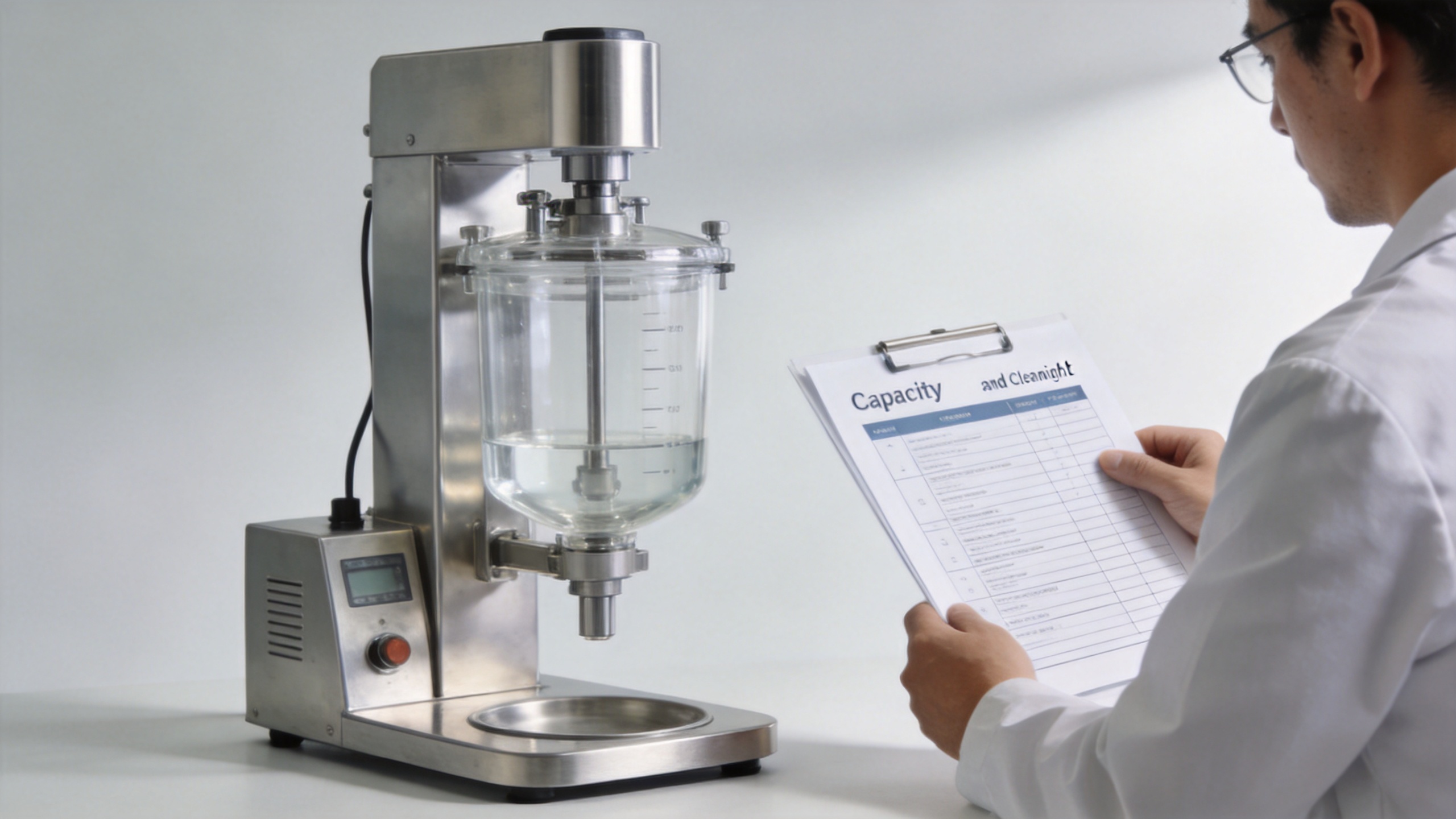
4. Review operation, containment, and sample handling
Small-batch usability matters because a lab stirrer machine is often operated frequently by development staff. Confirm the charging height, cover arrangement, viewing access, interlocks, guarding, noise, vibration, and ergonomic requirements. Where powders are dusty, examine sealing interfaces and the planned connection to local extraction or containment equipment. Ask what happens during a power interruption and how settings are recovered.
Discharge deserves equal attention. A lab stirrer machine that blends well but retains material in corners, around seals, or beneath an agitator can compromise yield and make samples less representative. Request a demonstration of discharge, vessel removal where applicable, and inspection access before approving the configuration.
5. Make cleanability and documentation part of the specification
For pharmaceutical work, cleanability is a quality and scheduling issue, not an accessory. FDA guidance on 21 CFR 211.67 requires equipment to be cleaned and maintained to prevent contamination that could affect a drug product’s safety, identity, strength, quality, or purity. Therefore, the lab stirrer machine specification should identify product-contact materials, surface finish requirements, gasket locations, access points, cleaning method, and the documents needed to support the site’s cleaning approach.
Ask whether the proposed lab stirrer machine can be disassembled without specialist tools, where residues could accumulate, and what cleaning instructions are supplied. Where a clean-in-place approach is proposed, clarify its coverage and verification requirements rather than assuming it eliminates validation work. The equipment supplier should provide the drawings, manuals, and material information needed for the laboratory’s own risk assessment.
6. Evaluate supplier support and scale-up relevance
A purchase decision should include more than the machine itself. Verify factory acceptance or trial support, commissioning scope, operator training, spare-parts availability, lead time, warranty boundaries, and response routes for technical questions. For development teams, it is useful to ask how settings from the lab stirrer machine may inform subsequent pilot or production evaluation—while recognizing that scale-up requires its own testing.
For a project requiring a laboratory unit, buyers can review the available LABORATORY MIXER HSD product page and request configuration-specific information. The final decision should remain based on documented suitability for the material, process target, and site requirements.
Purchase checklist for a lab stirrer machine
- Define material properties, batch range, and the decision the trial must support.
- Confirm the recommended minimum and maximum working volume—not only total capacity.
- Compare mechanism, speed range, torque, and controls against the formulation risk.
- Review charging, discharge, containment, safety, and operator access.
- Specify product-contact materials, cleanability, and required documentation.
- Run a representative trial with agreed sampling and acceptance criteria.
- Document support, maintenance, and the limits of scale-up relevance before placing the order.
A suitable lab stirrer machine has a documented operating window for the real material and a practical path to repeatable laboratory work. By converting capacity, operating method, cleaning, and support into reviewable specifications, procurement teams can make a more defensible investment.